Silence in the High-Frequency Domain: Acoustic Encapsulation Strategies for EV Electric Motors

Silence in the High-Frequency Domain: Acoustic Encapsulation Strategies for EV Electric Motors

The transition to electric mobility has fundamentally altered the automotive acoustic landscape. While the removal of the internal combustion engine (ICE) has eliminated the low-frequency “rumble” of pistons and explosions, it has unveiled a new, more piercing set of acoustic challenges. In the 2026 automotive market, where cabin silence is a primary metric of luxury, the high-frequency “whine” emanating from electric drive units has become the preeminent NVH (Noise, Vibration, and Harshness) hurdle.

1. The NVH Paradigm Shift

In legacy ICE vehicles, the engine functioned as an acoustic “mask.” Its broadband noise profile naturally obscured the lower-level mechanical and electrical sounds of the powertrain. In an electric vehicle (EV), that mask is gone. Occupants are now sensitive to the high-frequency tonal noise generated by the drive unit, particularly the inverter switching frequencies and electromagnetic forces within the motor. Because this noise is tonal—often occurring in the 5 kHz to 20 …

View More Silence in the High-Frequency Domain: Acoustic Encapsulation Strategies for EV Electric Motors
The Second-Hand Surge: How EV Incentive Phase-Outs Are Driving the Pre-Owned Market

The Second-Hand Surge: How EV Incentive Phase-Outs Are Driving the Pre-Owned Market

For several years, the narrative surrounding electric vehicle (EV) adoption was dictated by government largesse. Tax credits, purchase rebates, and infrastructure grants formed the scaffolding upon which the transition to electric mobility was built. But as we move through 2026, the industry is witnessing a profound shift: the era of “subsidy-driven” growth is giving way to a more mature, value-driven market.

While the sunsetting of federal and regional tax credits has caused a temporary softening in new EV sales—a drop of nearly 28% in the U.S. in Q1 2026—this policy transition has paradoxically triggered a golden age for the pre-owned EV market.

1. The Post-Subsidy Paradox

The divergence between new and used EV performance in 2026 is one of the most significant trends in automotive history. As federal tax credits for new EVs have become more restrictive or expired entirely, the “new car” barrier for middle-class consumers has risen. Financing …

View More The Second-Hand Surge: How EV Incentive Phase-Outs Are Driving the Pre-Owned Market
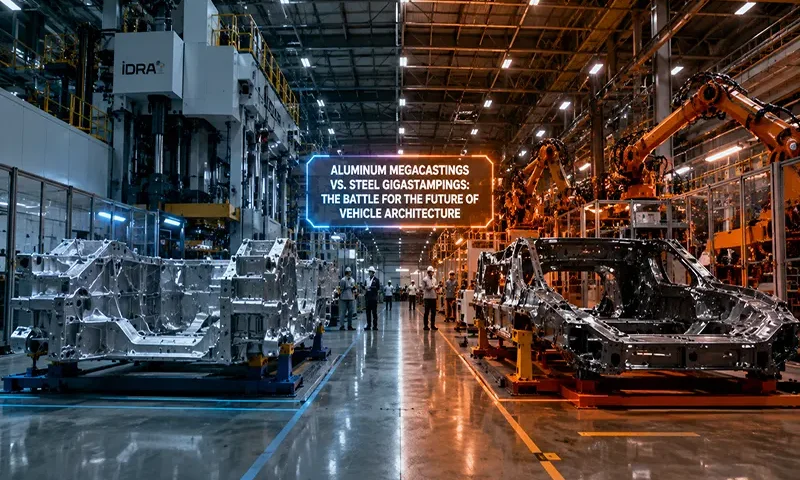
Aluminum Megacastings vs. Steel Gigastampings: The Battle for the Future of Vehicle Architecture

Aluminum Megacastings vs. Steel Gigastampings: The Battle for the Future of Vehicle Architecture

In the high-stakes world of automotive manufacturing, 2026 marks a decisive turning point. As electrification forces a radical rethinking of vehicle platforms, two competing ideologies are vying for dominance in the body-in-white (BIW) structure: the radical parts-consolidation of aluminum megacasting and the high-strength, precision-engineered optimization of advanced steel gigastamping.

1. The Architecture Pivot

For years, the industry was defined by incremental assembly. Today, we have reached an inflection point. Aluminum megacasting—the process of using massive 8,000+ ton “Giga Presses” to create large structural chassis components—promises to eliminate hundreds of individual parts and thousands of fasteners. Conversely, the steel industry is fighting back with a “Future Steel” resurgence, leveraging Advanced High-Strength Steel (AHSS) and tailored blanking techniques to match aluminum’s weight targets while preserving the manufacturing flexibility that traditional automakers have perfected over a century.

2. The Case for Aluminum Megacasting: Radical Consolidation

The allure of megacasting is simple: simplicity. …

View More Aluminum Megacastings vs. Steel Gigastampings: The Battle for the Future of Vehicle Architecture
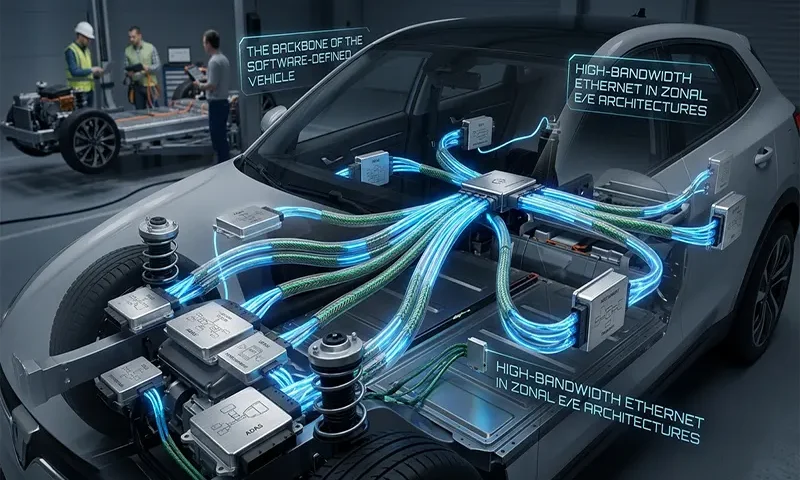
The Backbone of the Software-Defined Vehicle: High-Bandwidth Ethernet in Zonal E/E Architectures

The Backbone of the Software-Defined Vehicle: High-Bandwidth Ethernet in Zonal E/E Architectures

As the automotive industry pivots toward the Software-Defined Vehicle (SDV), the constraints of traditional distributed electronic architectures have become impossible to ignore. For decades, vehicles relied on domain-based architectures, where discrete Electronic Control Units (ECUs) managed isolated functions via low-bandwidth protocols like CAN and LIN. Today, with the surge in ADAS sensor fusion, autonomous driving capabilities, and AI-driven cockpit experiences, those legacy networks have reached a breaking point. The solution is the Zonal E/E Architecture, powered by a high-bandwidth, deterministic Ethernet backbone.

1. The Architecture Shift: From Domains to Zones

The transition to zonal architecture represents a fundamental mindset shift in vehicle design. Instead of grouping ECUs by function (e.g., powertrain, body, infotainment), a zonal architecture organizes the vehicle by physical location: front-left, front-right, rear-left, rear-right, and cabin.

In this framework, Zonal Control Units (ZCUs) act as local gateways, aggregating sensor data and power distribution for their specific geographic …

View More The Backbone of the Software-Defined Vehicle: High-Bandwidth Ethernet in Zonal E/E Architectures
PPF vs. Ceramic Coating: Which One Does Your New Car Actually Need?

PPF vs. Ceramic Coating: Which One Does Your New Car Actually Need?

Buying a new car usually comes with a second decision close behind it: how do you keep that fresh paint looking new? Two options dominate the conversation today—paint protection film and ceramic coating. They often get mentioned together, but they do very different jobs. If you treat them like interchangeable products, you’re likely to spend money on the wrong solution.

For drivers weighing paint protection film in Winston-Salem NC, the first thing to know is that PPF and ceramic coating solve different problems. One acts as a physical shield. The other helps the surface stay slick, glossy, and easier to clean. Once that difference is clear, choosing between them becomes much easier.

The short answer

  • If your main concern is rock chips, road debris, and minor abrasions, PPF is the better fit. 
  • If your priority is easier maintenance, water beading, and a polished look, ceramic coating makes more sense. 
View More PPF vs. Ceramic Coating: Which One Does Your New Car Actually Need?
Beyond the Lab: The Real-World Range and Performance of Semi-Solid-State Batteries in 2026

Beyond the Lab: The Real-World Range and Performance of Semi-Solid-State Batteries in 2026

For a decade, the automotive industry has chased the “holy grail” of all-solid-state batteries—promising the safety of non-flammable materials and the energy density to power electric vehicles for over 1,000 kilometers on a single charge. As of mid-2026, that dream has matured into a pragmatic, industrial reality. While the all-solid-state battery remains in the pilot-validation phase, the semi-solid-state (SSS) battery has emerged as the definitive commercial solution for the premium EV segment.

1. The “Interim” Revolution

In 2026, the industry has settled into a “large-scale commercialization” phase for SSS technology. Unlike true solid-state cells, which replace all liquid components with solid electrolytes, SSS batteries retain a small fraction (typically 5% to 20%) of liquid electrolyte.

This hybrid architecture is the “bridge” technology the industry desperately needed. By maintaining a small liquid fraction, SSS cells avoid the interfacial brittleness and crack-formation issues that have stalled all-solid-state development. More importantly, they are …

View More Beyond the Lab: The Real-World Range and Performance of Semi-Solid-State Batteries in 2026