
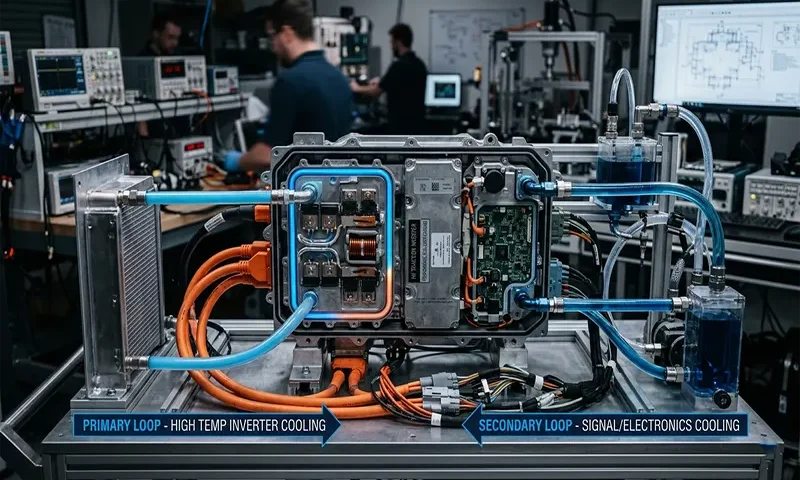
As the electric vehicle (EV) industry pushes toward 800V architectures and higher power densities, the traction inverter—the heart of the electric powertrain—has become a significant thermal bottleneck. With the widespread adoption of Silicon Carbide (SiC) MOSFETs, inverters are operating at higher switching frequencies and higher efficiencies than ever before. Yet, these advancements concentrate heat flux into smaller silicon footprints, pushing conventional single-loop cooling systems to their physical limits. For high-performance traction inverters, the transition to a dual-loop cooling architecture is no longer optional; it is a fundamental design requirement for thermal stability and peak performance.
1. The Thermal Limit of Single-Loop Architectures
Traditionally, many EVs utilized a single coolant loop to manage the battery, motor, and inverter. While this simplifies the Bill of Materials (BOM), it creates a fundamental thermal conflict. The lithium-ion battery pack typically requires a narrow operating window (20°C–35°C) for optimal health and longevity. In contrast, power …
View More EV Dual-Loop Cooling System Design for High-Performance Traction Inverters