
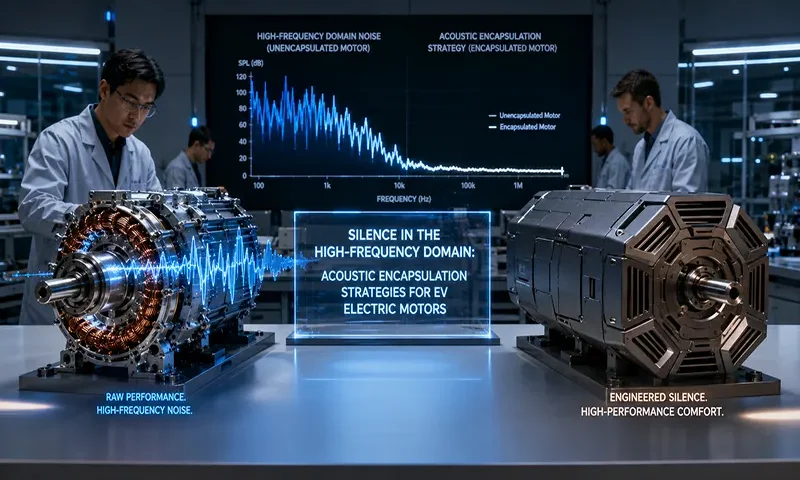
The transition to electric mobility has fundamentally altered the automotive acoustic landscape. While the removal of the internal combustion engine (ICE) has eliminated the low-frequency “rumble” of pistons and explosions, it has unveiled a new, more piercing set of acoustic challenges. In the 2026 automotive market, where cabin silence is a primary metric of luxury, the high-frequency “whine” emanating from electric drive units has become the preeminent NVH (Noise, Vibration, and Harshness) hurdle.
1. The NVH Paradigm Shift
In legacy ICE vehicles, the engine functioned as an acoustic “mask.” Its broadband noise profile naturally obscured the lower-level mechanical and electrical sounds of the powertrain. In an electric vehicle (EV), that mask is gone. Occupants are now sensitive to the high-frequency tonal noise generated by the drive unit, particularly the inverter switching frequencies and electromagnetic forces within the motor. Because this noise is tonal—often occurring in the 5 kHz to 20 …
View More Silence in the High-Frequency Domain: Acoustic Encapsulation Strategies for EV Electric Motors