
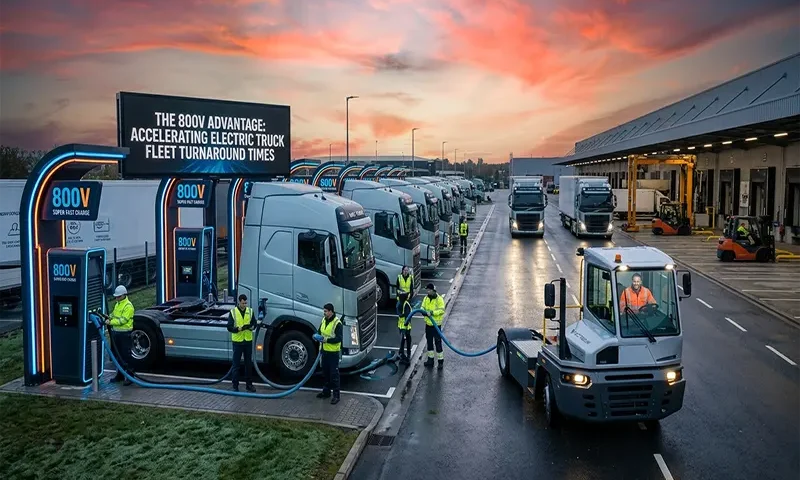
The 800V Advantage: Accelerating Electric Truck Fleet Turnaround Times

For heavy-duty electric vehicle (HDV) fleet operators, the primary metric of success is not just energy efficiency—it is uptime. In the world of logistics, a vehicle that is not moving is not earning. As electrification scales, the limitations of traditional 400V architectures are becoming a significant operational bottleneck, particularly when it comes to the time required to charge the massive battery packs needed for long-haul transport.

In 2026, the transition to 800V high-voltage architecture has moved from a luxury passenger-car trend to a fundamental requirement for the logistics industry. This shift is the primary enabler for the next generation of fleet productivity.

1. The Operational Bottleneck: Why 400V is Reaching Its Limit

Traditional 400V charging systems were designed for passenger vehicles with battery capacities typically ranging from 50–100 kWh. Scaling this architecture for an electric semi-truck with a 500+ kWh battery pack creates a massive throughput problem.

To achieve …

View More The 800V Advantage: Accelerating Electric Truck Fleet Turnaround Times


The Ultimate Senior Bike Sizing Guide for 2026

The Ultimate Senior Bike Sizing Guide for 2026

For many seniors, rediscovering the joy of cycling is about more than just fitness—it’s about independence, fresh air, and the freedom to explore. However, the most common barrier to a great ride isn’t age; it’s a poorly fitted bike.At Viribus, we believe your bike should adapt to you, not the other way around. Whether you’re looking at a traditional two-wheeler or one of our electric bike for adults, getting the size right is the first step toward a safe and comfortable journey.

Why Bike Sizing Matters More as We Age

As we get older, comfort and safety become non-negotiable. An improperly sized e-bike can lead to:

  • Joint Strain: Improper leg extension can stress the knees and hips.
  • Reduced Control: If the frame is too large, reaching the ground or the handlebars becomes a safety hazard.
  • Mounting Difficulties: A frame that is too high makes it difficult to get
View More The Ultimate Senior Bike Sizing Guide for 2026
Breaking the Winter Barrier: Why Sodium-Ion Batteries are the Future of Cold-Weather EVs

Breaking the Winter Barrier: Why Sodium-Ion Batteries are the Future of Cold-Weather EVs

For years, “winter range anxiety” has been the primary barrier to mass electric vehicle (EV) adoption in northern latitudes. As temperatures drop, lithium-ion batteries—both the premium NMC and the mainstream LFP—face a triple threat: increased internal resistance, sluggish ion mobility, and the “parasitic” energy drain of active battery heating systems.

However, as of 2026, a shift is underway. Sodium-ion (SIB) battery technology is moving from the lab to the road, offering a solution that doesn’t just manage the cold—it thrives in it.

1. The Winter Dilemma: Why Lithium Struggles

To understand the breakthrough of sodium-ion, we must first look at why our current batteries struggle. In freezing temperatures, the electrolyte inside a lithium-ion battery becomes more viscous, slowing down the movement of ions.

Even more critical is the phenomenon of lithium plating. When charging a standard LFP battery below 0°C, lithium ions move too slowly to effectively insert themselves …

View More Breaking the Winter Barrier: Why Sodium-Ion Batteries are the Future of Cold-Weather EVs