
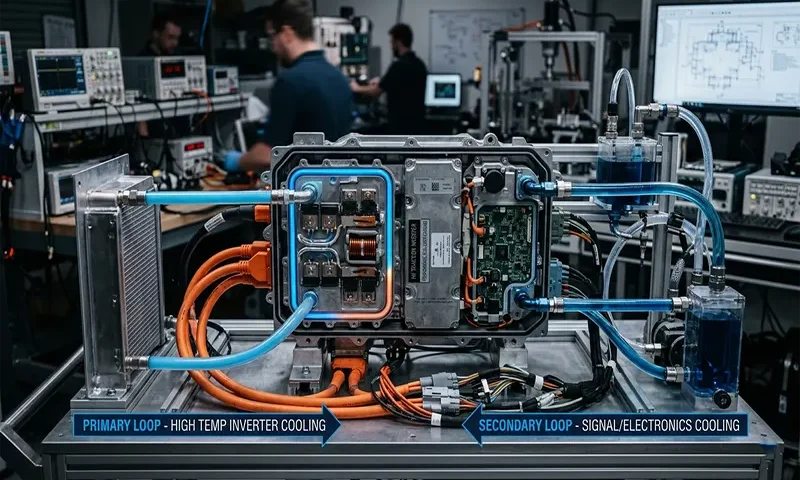
EV Dual-Loop Cooling System Design for High-Performance Traction Inverters

EV Dual-Loop Cooling System Design for High-Performance Traction Inverters

As the electric vehicle (EV) industry pushes toward 800V architectures and higher power densities, the traction inverter—the heart of the electric powertrain—has become a significant thermal bottleneck. With the widespread adoption of Silicon Carbide (SiC) MOSFETs, inverters are operating at higher switching frequencies and higher efficiencies than ever before. Yet, these advancements concentrate heat flux into smaller silicon footprints, pushing conventional single-loop cooling systems to their physical limits. For high-performance traction inverters, the transition to a dual-loop cooling architecture is no longer optional; it is a fundamental design requirement for thermal stability and peak performance.

1. The Thermal Limit of Single-Loop Architectures

Traditionally, many EVs utilized a single coolant loop to manage the battery, motor, and inverter. While this simplifies the Bill of Materials (BOM), it creates a fundamental thermal conflict. The lithium-ion battery pack typically requires a narrow operating window (20°C–35°C) for optimal health and longevity. In contrast, power …

View More EV Dual-Loop Cooling System Design for High-Performance Traction Inverters
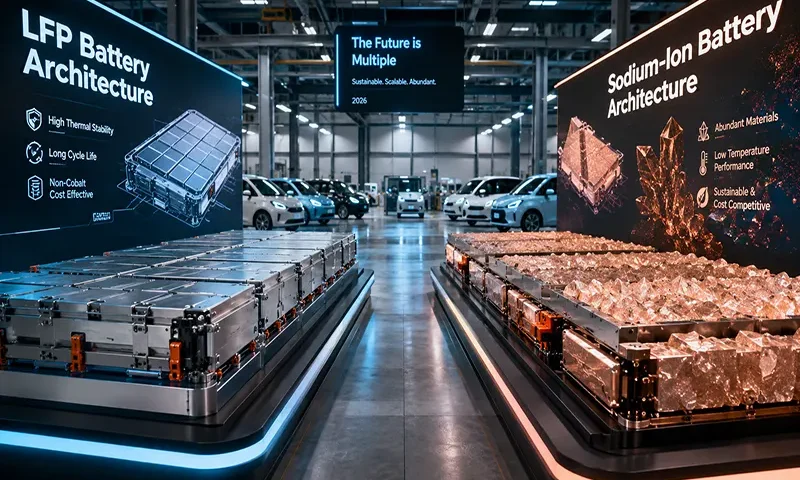
Sodium-Ion vs. LFP: The Cost Evolution for Urban Electric Vehicles in 2026

Sodium-Ion vs. LFP: The Cost Evolution for Urban Electric Vehicles in 2026

The electric vehicle (EV) battery landscape in 2026 is no longer a singular race toward higher energy density. As the industry matures, the focus has shifted toward cost-optimization, supply chain security, and use-case specialization. At the center of this debate are two chemistries: Lithium Iron Phosphate (LFP), the proven incumbent of the mass market, and Sodium-Ion (SIB), the rapidly rising challenger.

For urban electric vehicles—where range requirements are often secondary to cost and charging frequency—this comparison has become the most critical strategic decision for manufacturers and fleet operators alike.

1. Executive Summary: A Market in Transition

In 2026, LFP remains the “bankable” choice for mainstream passenger EVs. With over half of global EV batteries now utilizing LFP, the chemistry benefits from massive economies of scale, a mature manufacturing infrastructure, and established safety records.

However, Sodium-Ion has moved from the laboratory to mass production. While it is not yet …

View More Sodium-Ion vs. LFP: The Cost Evolution for Urban Electric Vehicles in 2026