
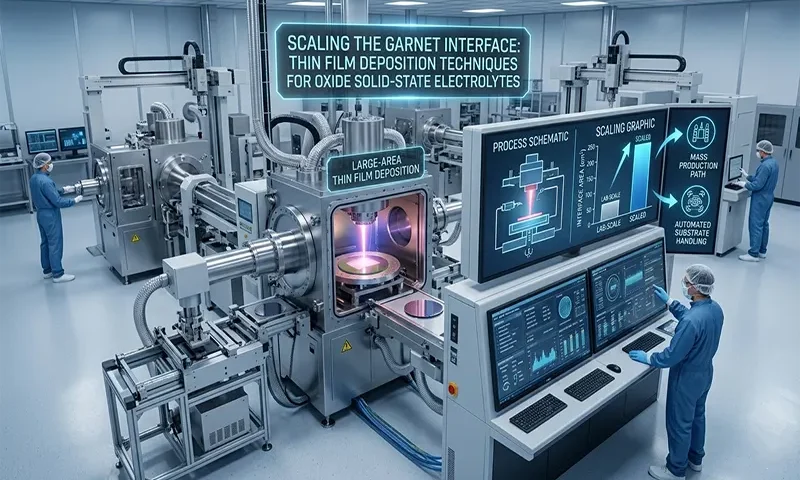
Scaling the Garnet Interface: Thin Film Deposition Techniques for Oxide Solid-State Electrolytes

Scaling the Garnet Interface: Thin Film Deposition Techniques for Oxide Solid-State Electrolytes

As the battery industry transitions from laboratory-scale innovation to 2026-era mass production, the “garnet” class of oxide solid-state electrolytes (SSEs)—most notably Lithium Lanthanum Zirconium Oxide (LLZO)—has emerged as a frontrunner. Praised for its high ionic conductivity and remarkable electrochemical stability against lithium metal, LLZO is the cornerstone of the next generation of high-energy-density batteries. However, the path to commercialization is blocked by a stubborn manufacturing bottleneck: the brittle, ceramic nature of garnets and the prohibitive energy cost of traditional high-temperature sintering.

1. The Garnet Promise

Garnet-type electrolytes, such as cubic-phase LLZO, offer a superior combination of high room-temperature ionic conductivity (>1 mS/cm) and a wide electrochemical stability window. Unlike sulfide electrolytes, which are highly sensitive to moisture and require strictly inert manufacturing environments, oxide-based garnets are chemically robust. Yet, they remain notoriously difficult to process. Achieving a dense, flaw-free ceramic separator thinner than 20 μm—the threshold needed to compete with …

View More Scaling the Garnet Interface: Thin Film Deposition Techniques for Oxide Solid-State Electrolytes
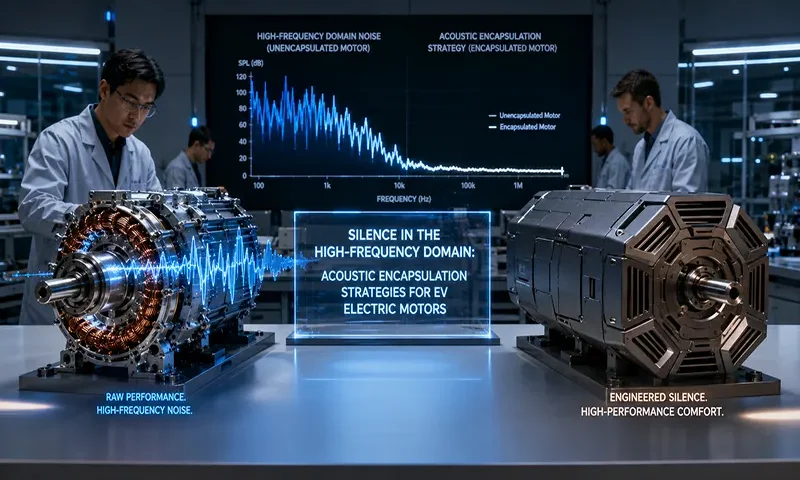
Silence in the High-Frequency Domain: Acoustic Encapsulation Strategies for EV Electric Motors

Silence in the High-Frequency Domain: Acoustic Encapsulation Strategies for EV Electric Motors

The transition to electric mobility has fundamentally altered the automotive acoustic landscape. While the removal of the internal combustion engine (ICE) has eliminated the low-frequency “rumble” of pistons and explosions, it has unveiled a new, more piercing set of acoustic challenges. In the 2026 automotive market, where cabin silence is a primary metric of luxury, the high-frequency “whine” emanating from electric drive units has become the preeminent NVH (Noise, Vibration, and Harshness) hurdle.

1. The NVH Paradigm Shift

In legacy ICE vehicles, the engine functioned as an acoustic “mask.” Its broadband noise profile naturally obscured the lower-level mechanical and electrical sounds of the powertrain. In an electric vehicle (EV), that mask is gone. Occupants are now sensitive to the high-frequency tonal noise generated by the drive unit, particularly the inverter switching frequencies and electromagnetic forces within the motor. Because this noise is tonal—often occurring in the 5 kHz to 20 …

View More Silence in the High-Frequency Domain: Acoustic Encapsulation Strategies for EV Electric Motors