
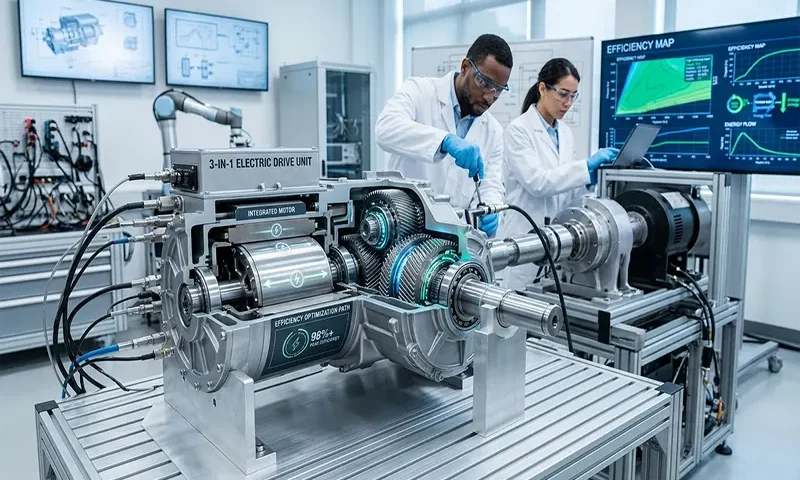
In the competitive landscape of 2026, the “3-in-1” electric drive unit—integrating the motor, inverter, and gearbox into a single housing—has become the industry standard for high-performance EVs. As manufacturers shift from parallel-offset gearboxes to coaxial (inline) designs, the focus has moved toward a sophisticated multi-objective optimization problem: balancing mechanical efficiency, thermal density, and electronic control.
1. The Coaxial Advantage
Traditional parallel-offset gearboxes, while robust, introduce inherent packaging constraints and increased mass. Coaxial arrangements, where the motor shaft and output shaft are aligned, allow for a significantly more compact “cigar-shaped” profile. This reduces the overall vehicle footprint, improves NVH (Noise, Vibration, and Harshness) profiles by aligning rotating masses, and simplifies chassis integration. By optimizing the torque path to be direct, coaxial systems reduce the number of required gear meshes, directly lowering the internal friction and parasitic drag of the system.
2. Mechanical Efficiency of Coaxial Gears
The heart of a high-efficiency …
View More Efficiency Optimization of 3-in-1 Electric Drive Units with Coaxial Gears