As the battery industry transitions from laboratory-scale innovation to 2026-era mass production, the “garnet” class of oxide solid-state electrolytes (SSEs)—most notably Lithium Lanthanum Zirconium Oxide (LLZO)—has emerged as a frontrunner. Praised for its high ionic conductivity and remarkable electrochemical stability against lithium metal, LLZO is the cornerstone of the next generation of high-energy-density batteries. However, the path to commercialization is blocked by a stubborn manufacturing bottleneck: the brittle, ceramic nature of garnets and the prohibitive energy cost of traditional high-temperature sintering.
1. The Garnet Promise
Garnet-type electrolytes, such as cubic-phase LLZO, offer a superior combination of high room-temperature ionic conductivity (>1 mS/cm) and a wide electrochemical stability window. Unlike sulfide electrolytes, which are highly sensitive to moisture and require strictly inert manufacturing environments, oxide-based garnets are chemically robust. Yet, they remain notoriously difficult to process. Achieving a dense, flaw-free ceramic separator thinner than 20 μm—the threshold needed to compete with current liquid-electrolyte separators—using conventional tape casting and sintering (>1050°C) is both slow and expensive.
2. The Deposition Landscape: From Vacuum to Solution
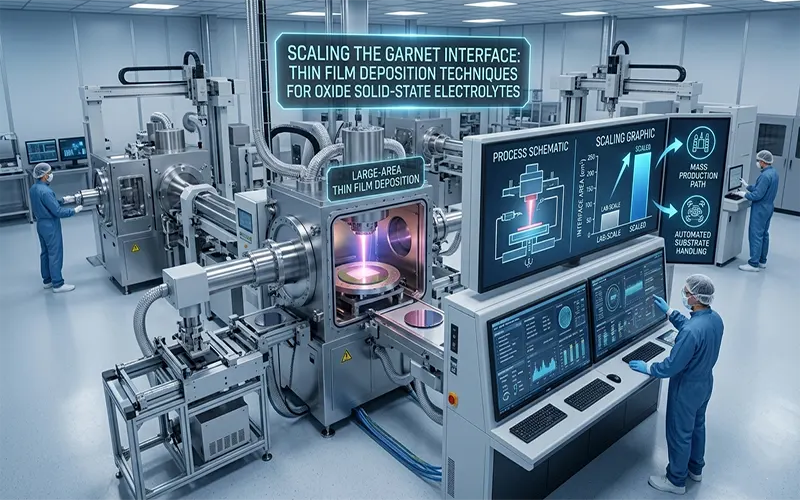
To move beyond bulk sintering, the industry is increasingly looking toward thin-film deposition techniques that enable precise control over film thickness, stoichiometry, and interface morphology.
- Pulsed Laser Deposition (PLD): This technique remains the gold standard for high-quality, crystalline garnet research. By ablating a stoichiometric target with a laser, researchers can grow epitaxial-like films with near-perfect atomic arrangement. However, its low throughput and line-of-sight deposition make it unsuitable for Giga-scale battery production.
- Magnetron Sputtering: Widely considered the most viable for industrial scaling, sputtering allows for larger area coverage. The primary challenge remains stoichiometric control—maintaining the precise La/Zr/Ta ratios across large substrates. Current 2026 industrial protocols utilize multi-target co-sputtering, allowing for real-time compensation of lithium loss during the vacuum process.
- Atomic Layer Deposition (ALD) & CVD: These methods are currently being leveraged for “interfacial modification” rather than bulk electrolyte growth. ALD enables the deposition of ultra-thin, pinhole-free layers (1–20 nm) that act as functional buffers, preventing the formation of resistive interlayers (like $Li_2CO_3$) that typically form upon air exposure.
3. The Scaling Challenge: Bypassing the Sintering Bottleneck
The critical hurdle for LLZO is stabilizing the high-conductivity cubic phase. Traditionally, this required high-temperature sintering, which causes significant lithium volatility and micro-cracking due to coefficient of thermal expansion (CTE) mismatches.
The industry is now shifting toward low-temperature densification. By utilizing precursor chemistries that allow for simultaneous phase formation and crystallization, manufacturers are reducing the thermal budget. Techniques that enable densification at temperatures below 750°C—or even lower—are critical for compatibility with cost-effective metal current collectors or polymer substrates.
4. Interfacial Engineering: Solving the Wettability Gap
A defining characteristic of garnets is their “lithiophobic” nature; molten lithium metal does not naturally wet the ceramic surface, leading to high interfacial impedance and poor battery performance. Thin-film deposition is being repurposed to solve this. By depositing sub-micron layers of lithiophilic materials—such as silicon nitride ($Si_3N_4$), antimony ($Sb$), or even thin metallic zinc—manufacturers are transforming the interface. These “wetting layers” undergo an alloying reaction with the lithium, ensuring intimate contact and enabling the high critical current densities (CCD) required for fast charging.
5. Emerging “Sinter-Free” Strategies
Perhaps the most disruptive trend in 2026 is the adoption of Sequential Decomposition Synthesis (SDS) and other sinter-free routes. These liquid-to-solid manufacturing approaches involve depositing a precursor “sol-gel” or ink directly onto a carrier, followed by a controlled low-temperature annealing process. This process bypasses the need for high-pressure or high-temperature sintering, enabling the continuous, roll-to-roll production of ceramic separators that are dense, homogenous, and thinner than 10 μm.
6. Future Outlook: The Road to 2030
As we look toward the remainder of the decade, the focus of SSE development is shifting. The era of obsessing over bulk conductivity in laboratory-scale pellets is yielding to a focus on process integration. The goal for 2030 is clear: the production of sub-20 μm ceramic membranes that can be integrated into high-throughput manufacturing lines at costs competitive with current polyolefin separators.
By combining thin-film surface engineering with sinter-free processing, the battery industry is finally turning the “brittle ceramic” challenge into a manufacturing opportunity. As garnet electrolytes move from the lab to the assembly line, they are not just replacing liquid electrolytes—they are enabling the next leap in automotive energy density, safety, and reliability.