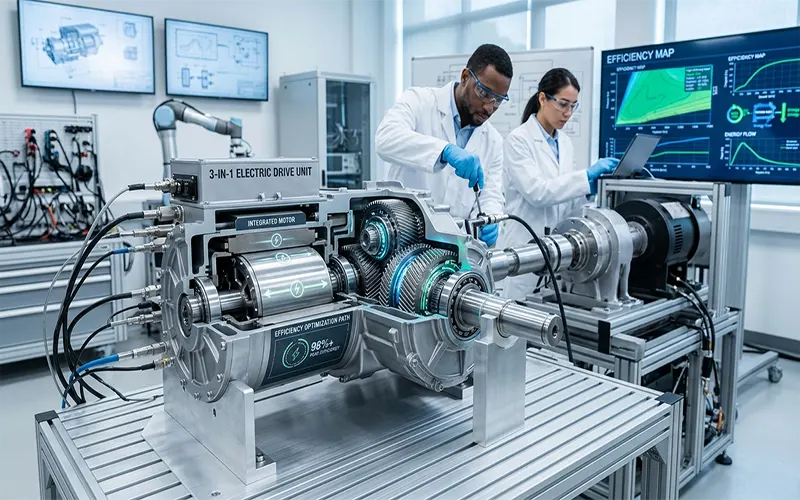
In the competitive landscape of 2026, the “3-in-1” electric drive unit—integrating the motor, inverter, and gearbox into a single housing—has become the industry standard for high-performance EVs. As manufacturers shift from parallel-offset gearboxes to coaxial (inline) designs, the focus has moved toward a sophisticated multi-objective optimization problem: balancing mechanical efficiency, thermal density, and electronic control.
1. The Coaxial Advantage
Traditional parallel-offset gearboxes, while robust, introduce inherent packaging constraints and increased mass. Coaxial arrangements, where the motor shaft and output shaft are aligned, allow for a significantly more compact “cigar-shaped” profile. This reduces the overall vehicle footprint, improves NVH (Noise, Vibration, and Harshness) profiles by aligning rotating masses, and simplifies chassis integration. By optimizing the torque path to be direct, coaxial systems reduce the number of required gear meshes, directly lowering the internal friction and parasitic drag of the system.
2. Mechanical Efficiency of Coaxial Gears
The heart of a high-efficiency coaxial unit is often a planetary gear set. Efficiency here is driven by two primary factors: gear tooth contact dynamics and lubrication.
- Gear Geometry: By utilizing advanced profile shifting and micro-geometry optimization, engineers can maximize the contact ratio, ensuring that loads are distributed across multiple teeth to reduce localized stress and friction.
- Lubrication Dynamics: At the high rotational speeds (up to 20,000+ RPM) common in 2026-era motors, “churning loss” becomes a dominant factor. Optimization involves utilizing active spray-lubrication systems that precisely target gear meshes, ensuring that the oil film is sufficient for protection without creating unnecessary drag through excessive immersion.
3. The Integration Challenge: Shared Housing
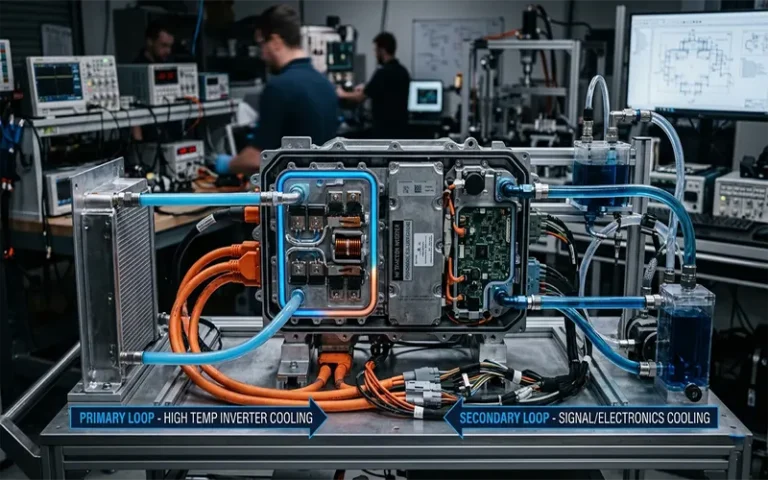
The 3-in-1 approach presents a complex thermal and structural conflict. Integrating an inverter (which has a lower thermal threshold) with a motor (a significant heat source) requires a holistic thermal strategy.
- Electromagnetic Interference (EMI): With the inverter mounted directly onto the motor, EMI shielding becomes critical. Optimization requires precise housing geometry that acts as a Faraday cage, preventing high-frequency switching noise from the SiC (Silicon Carbide) inverters from interfering with motor position sensors.
- Structural Rigidity: The shared housing must maintain coaxial alignment even under extreme thermal expansion cycles. Modern units use high-strength aluminum alloys and topology-optimized ribbing to ensure that gear mesh patterns do not shift as temperatures fluctuate during aggressive driving.
4. Thermal Management: Proactive vs. Reactive
Efficiency is compromised when cooling systems operate in a reactive state. 2026-era drive units employ proactive, AI-driven thermal management. By leveraging predictive data from the Vehicle Control Unit (VCU)—such as upcoming elevation changes or throttle patterns—the drive unit pre-cools the inverter and motor segments before high-load events. This minimizes the “derating” phenomenon and ensures the system operates in its peak efficiency “island” for longer durations, preventing the energy waste associated with running auxiliary cooling pumps at maximum capacity when unnecessary.
5. Control Strategy: The Efficiency Nexus
The inverter’s switching frequency is a key lever for efficiency. Higher switching frequencies reduce current ripple, which lowers motor iron losses, but they increase switching losses in the SiC power modules.
- Variable-Frequency Control: The VCU dynamically adjusts the switching frequency based on the motor’s operating point. At low speeds/high torque, the system optimizes for torque ripple reduction; at high-speed cruise, it shifts to lower frequencies to maximize inverter efficiency.
- Gearbox-Motor Synergy: The control software manages the electric motor’s field-oriented control (FOC) to ensure that the motor is always operating at the highest possible efficiency point given the fixed or multi-ratio gear reduction.
6. Future Outlook
The next frontier for the 3-in-1 unit is the widespread adoption of dielectric immersion cooling. By circulating non-conductive coolant directly over the motor windings and power electronics, the thermal resistance between the heat source and the cooling fluid is slashed. When paired with next-generation wide-bandgap semiconductors, these optimized 3-in-1 units will continue to push the boundaries of power density, enabling lighter, more efficient, and more capable electric vehicles.
Optimizing a 3-in-1 coaxial drive unit is not about improving one component, but about managing the synergy between three distinct systems. Through the combination of advanced gear micro-geometries, proactive thermal strategies, and intelligent power electronics, engineers have turned the compact coaxial drive unit into the defining mechanical achievement of the 2026 electric powertrain.