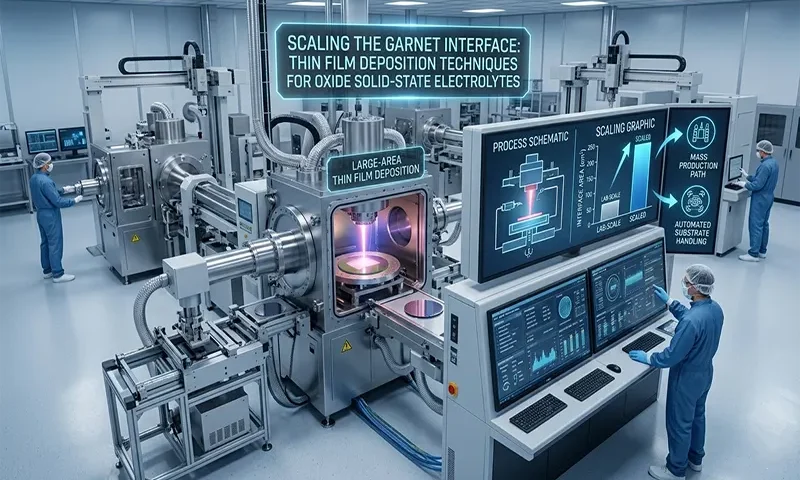
Scaling the Garnet Interface: Thin Film Deposition Techniques for Oxide Solid-State Electrolytes

Scaling the Garnet Interface: Thin Film Deposition Techniques for Oxide Solid-State Electrolytes

As the battery industry transitions from laboratory-scale innovation to 2026-era mass production, the “garnet” class of oxide solid-state electrolytes (SSEs)—most notably Lithium Lanthanum Zirconium Oxide (LLZO)—has emerged as a frontrunner. Praised for its high ionic conductivity and remarkable electrochemical stability against lithium metal, LLZO is the cornerstone of the next generation of high-energy-density batteries. However, the path to commercialization is blocked by a stubborn manufacturing bottleneck: the brittle, ceramic nature of garnets and the prohibitive energy cost of traditional high-temperature sintering.

1. The Garnet Promise

Garnet-type electrolytes, such as cubic-phase LLZO, offer a superior combination of high room-temperature ionic conductivity (>1 mS/cm) and a wide electrochemical stability window. Unlike sulfide electrolytes, which are highly sensitive to moisture and require strictly inert manufacturing environments, oxide-based garnets are chemically robust. Yet, they remain notoriously difficult to process. Achieving a dense, flaw-free ceramic separator thinner than 20 μm—the threshold needed to compete with …

View More Scaling the Garnet Interface: Thin Film Deposition Techniques for Oxide Solid-State Electrolytes
Aluminum Megacastings vs. Steel Gigastampings: The Battle for the Future of Vehicle Architecture

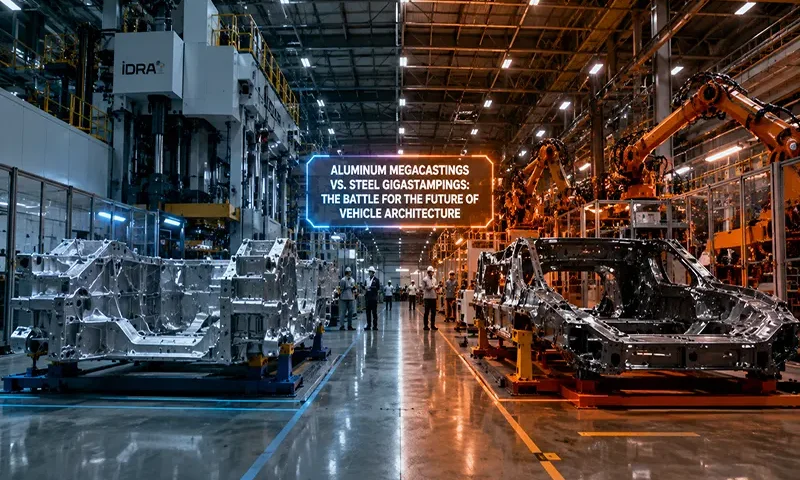
Aluminum Megacastings vs. Steel Gigastampings: The Battle for the Future of Vehicle Architecture

In the high-stakes world of automotive manufacturing, 2026 marks a decisive turning point. As electrification forces a radical rethinking of vehicle platforms, two competing ideologies are vying for dominance in the body-in-white (BIW) structure: the radical parts-consolidation of aluminum megacasting and the high-strength, precision-engineered optimization of advanced steel gigastamping.

1. The Architecture Pivot

For years, the industry was defined by incremental assembly. Today, we have reached an inflection point. Aluminum megacasting—the process of using massive 8,000+ ton “Giga Presses” to create large structural chassis components—promises to eliminate hundreds of individual parts and thousands of fasteners. Conversely, the steel industry is fighting back with a “Future Steel” resurgence, leveraging Advanced High-Strength Steel (AHSS) and tailored blanking techniques to match aluminum’s weight targets while preserving the manufacturing flexibility that traditional automakers have perfected over a century.

2. The Case for Aluminum Megacasting: Radical Consolidation

The allure of megacasting is simple: simplicity. …

View More Aluminum Megacastings vs. Steel Gigastampings: The Battle for the Future of Vehicle Architecture
The 800V Advantage: Accelerating Electric Truck Fleet Turnaround Times

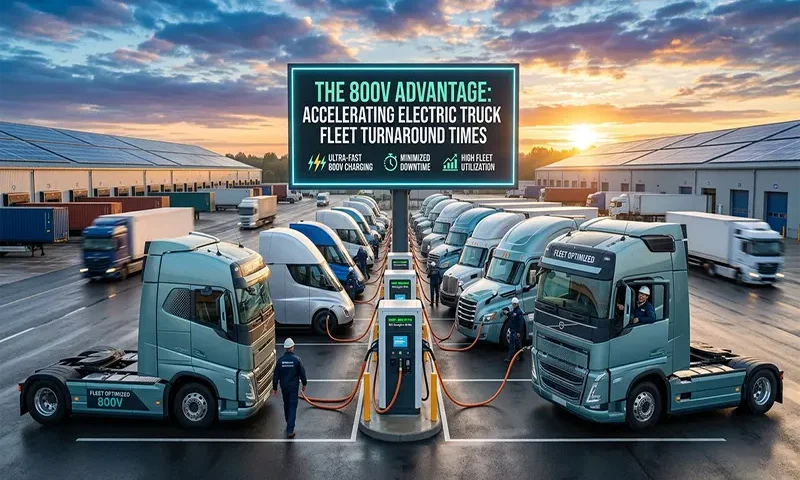
The 800V Advantage: Accelerating Electric Truck Fleet Turnaround Times

For heavy-duty electric vehicle (HDV) fleet operators, the primary metric of success is not just energy efficiency—it is uptime. In the world of logistics, a vehicle that is not moving is not earning. As electrification scales, the limitations of traditional 400V architectures are becoming a significant operational bottleneck, particularly when it comes to the time required to charge the massive battery packs needed for long-haul transport.

In 2026, the transition to 800V high-voltage architecture has moved from a luxury passenger-car trend to a fundamental requirement for the logistics industry. This shift is the primary enabler for the next generation of fleet productivity.

1. The Operational Bottleneck: Why 400V is Reaching Its Limit

Traditional 400V charging systems were designed for passenger vehicles with battery capacities typically ranging from 50–100 kWh. Scaling this architecture for an electric semi-truck with a 500+ kWh battery pack creates a massive throughput problem.

To achieve …

View More The 800V Advantage: Accelerating Electric Truck Fleet Turnaround Times
Breaking the Winter Barrier: Why Sodium-Ion Batteries are the Future of Cold-Weather EVs

Breaking the Winter Barrier: Why Sodium-Ion Batteries are the Future of Cold-Weather EVs

For years, “winter range anxiety” has been the primary barrier to mass electric vehicle (EV) adoption in northern latitudes. As temperatures drop, lithium-ion batteries—both the premium NMC and the mainstream LFP—face a triple threat: increased internal resistance, sluggish ion mobility, and the “parasitic” energy drain of active battery heating systems.

However, as of 2026, a shift is underway. Sodium-ion (SIB) battery technology is moving from the lab to the road, offering a solution that doesn’t just manage the cold—it thrives in it.

1. The Winter Dilemma: Why Lithium Struggles

To understand the breakthrough of sodium-ion, we must first look at why our current batteries struggle. In freezing temperatures, the electrolyte inside a lithium-ion battery becomes more viscous, slowing down the movement of ions.

Even more critical is the phenomenon of lithium plating. When charging a standard LFP battery below 0°C, lithium ions move too slowly to effectively insert themselves …

View More Breaking the Winter Barrier: Why Sodium-Ion Batteries are the Future of Cold-Weather EVs
Introduction of Connected Car Services

Introduction of Connected Car Services

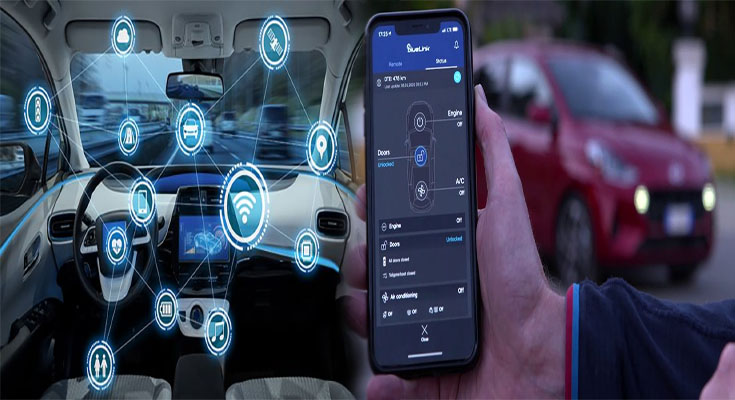
Connected car services are a growing ecosystem that enables a number of new functions in vehicles. These include automatic maintenance notifications, GPS and advanced parking / proximity awareness systems.

However, there are a few challenges to overcome before connected car services can be adopted widely by consumers. The main challenge is ensuring data security and the ability to provide an uninterrupted service, regardless of connectivity issues or failures.

Overview

Connected car services are a set of features offered by automakers to enhance the driving experience and increase safety. These features vary by make and model, but all aim to make travel safer and less stressful.

They may include free Apple CarPlay and Android Auto integration, subscription- based live concierge assistance, or a mix of both. These offerings are available from most automakers.

Connected car technology sends data and information to the vehicle, the cloud, other vehicles, smart city infrastructure, and …

View More Introduction of Connected Car Services
What Are Sustainable Transportation Ideas?

What Are Sustainable Transportation Ideas?

Sustainable transportation ideas are those that focus on creating a healthy balance between humans, vehicles and the environment. This includes economic, environmental and social considerations.

Transportation is one of the largest sources of greenhouse gases worldwide, accounting for 23% of total global emissions. Changing travel habits is essential to reducing pollution levels.

The Importance

Greener transport options reduce the emissions of CO2 and other damaging gases that contribute to climate change. They also improve air quality, which can lead to increased health and quality of life.

Sustainable transport is also a way to build a sustainable economy, by reducing the demand for fossil fuels and using energy sources that come from renewable resources such as wind or solar power. It can also help reduce traffic congestion by encouraging alternative modes of transportation such as walking and cycling.

A holistic approach to planning, designing, procuring, building and operating infrastructure is essential …

View More What Are Sustainable Transportation Ideas?