
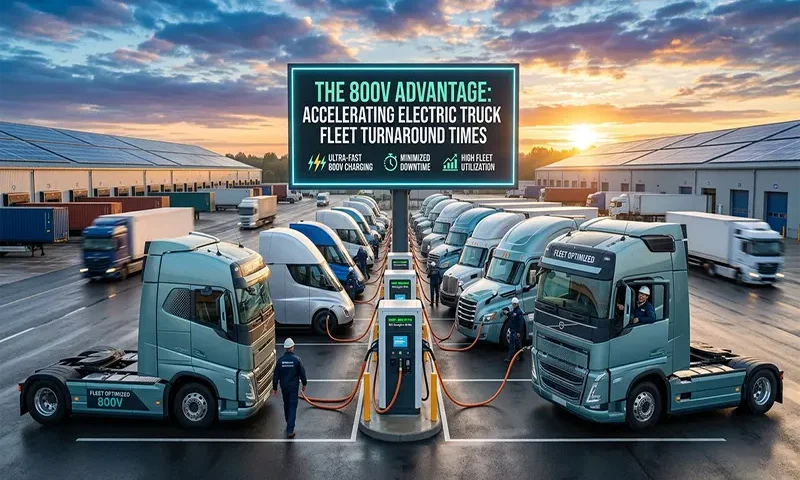
The 800V Advantage: Accelerating Electric Truck Fleet Turnaround Times

The 800V Advantage: Accelerating Electric Truck Fleet Turnaround Times

For heavy-duty electric vehicle (HDV) fleet operators, the primary metric of success is not just energy efficiency—it is uptime. In the world of logistics, a vehicle that is not moving is not earning. As electrification scales, the limitations of traditional 400V architectures are becoming a significant operational bottleneck, particularly when it comes to the time required to charge the massive battery packs needed for long-haul transport.

In 2026, the transition to 800V high-voltage architecture has moved from a luxury passenger-car trend to a fundamental requirement for the logistics industry. This shift is the primary enabler for the next generation of fleet productivity.

1. The Operational Bottleneck: Why 400V is Reaching Its Limit

Traditional 400V charging systems were designed for passenger vehicles with battery capacities typically ranging from 50–100 kWh. Scaling this architecture for an electric semi-truck with a 500+ kWh battery pack creates a massive throughput problem.

To achieve …

View More The 800V Advantage: Accelerating Electric Truck Fleet Turnaround Times
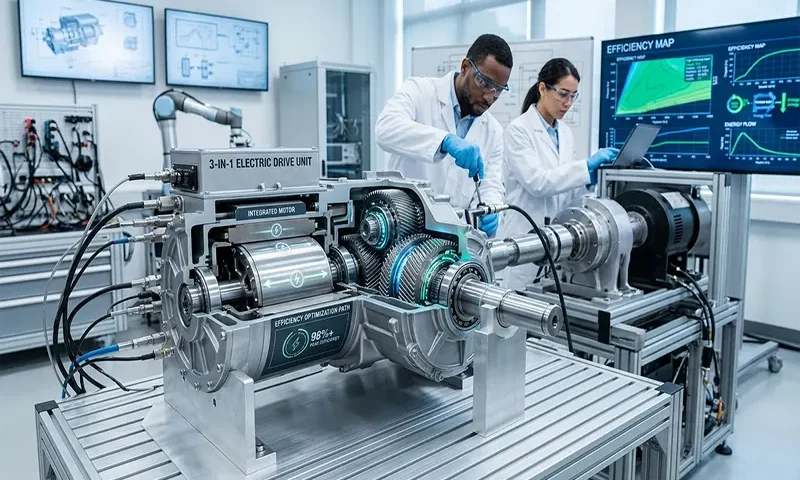
Efficiency Optimization of 3-in-1 Electric Drive Units with Coaxial Gears

Efficiency Optimization of 3-in-1 Electric Drive Units with Coaxial Gears

In the competitive landscape of 2026, the “3-in-1” electric drive unit—integrating the motor, inverter, and gearbox into a single housing—has become the industry standard for high-performance EVs. As manufacturers shift from parallel-offset gearboxes to coaxial (inline) designs, the focus has moved toward a sophisticated multi-objective optimization problem: balancing mechanical efficiency, thermal density, and electronic control.

1. The Coaxial Advantage

Traditional parallel-offset gearboxes, while robust, introduce inherent packaging constraints and increased mass. Coaxial arrangements, where the motor shaft and output shaft are aligned, allow for a significantly more compact “cigar-shaped” profile. This reduces the overall vehicle footprint, improves NVH (Noise, Vibration, and Harshness) profiles by aligning rotating masses, and simplifies chassis integration. By optimizing the torque path to be direct, coaxial systems reduce the number of required gear meshes, directly lowering the internal friction and parasitic drag of the system.

2. Mechanical Efficiency of Coaxial Gears

The heart of a high-efficiency …

View More Efficiency Optimization of 3-in-1 Electric Drive Units with Coaxial Gears