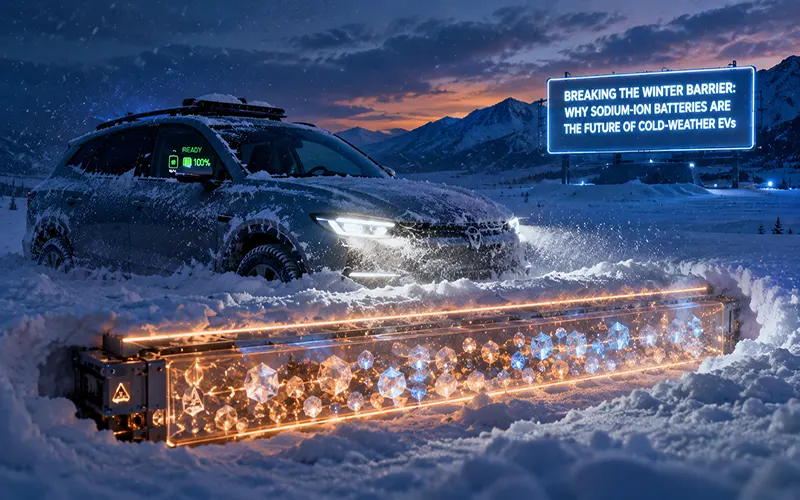
For years, “winter range anxiety” has been the primary barrier to mass electric vehicle (EV) adoption in northern latitudes. As temperatures drop, lithium-ion batteries—both the premium NMC and the mainstream LFP—face a triple threat: increased internal resistance, sluggish ion mobility, and the “parasitic” energy drain of active battery heating systems.
However, as of 2026, a shift is underway. Sodium-ion (SIB) battery technology is moving from the lab to the road, offering a solution that doesn’t just manage the cold—it thrives in it.
1. The Winter Dilemma: Why Lithium Struggles
To understand the breakthrough of sodium-ion, we must first look at why our current batteries struggle. In freezing temperatures, the electrolyte inside a lithium-ion battery becomes more viscous, slowing down the movement of ions.
Even more critical is the phenomenon of lithium plating. When charging a standard LFP battery below 0°C, lithium ions move too slowly to effectively insert themselves into the anode’s graphite structure. Instead, they coat the surface of the anode as metallic lithium. This not only causes immediate performance drops but can lead to permanent internal damage or short circuits. To prevent this, most EVs are programmed to disable fast-charging in the cold or activate high-energy-consuming heaters just to bring the pack to an operational temperature—draining precious range before the car even moves.
2. The Science of Sodium Resilience
Sodium-ion batteries function differently, largely due to their unique chemistry.
- Superior Ionic Mobility: While sodium ions are physically larger than lithium ions, they form weaker bonds with electrolyte molecules. In cold, viscous electrolytes, these weaker bonds allow sodium ions to detach and move with significantly less resistance than their lithium counterparts.
- Hard Carbon Advantage: SIBs typically utilize hard-carbon anodes rather than graphite. This structure provides more “spacing” for ions to move into, effectively eliminating the plating risks associated with lithium. This allows sodium-ion systems to charge safely in sub-zero conditions where a standard LFP system would lock out the charger entirely.
3. Real-World Benchmarks (2026 Data)
The difference in performance is measurable and significant. According to field data from 2026, while typical LFP batteries may struggle to maintain 60–70% of their capacity at -20°C, sodium-ion systems are consistently demonstrating 85–90% capacity retention under the same conditions.
| Performance Metric | Lithium Iron Phosphate (LFP) | Sodium-Ion (SIB) |
| Capacity at -20°C | 60% – 70% | 85% – 90% |
| Safe Charging Temp | Limited below 0°C | Down to -20°C (or lower) |
| Heating Dependency | High (Energy intensive) | Minimal (Passive) |
| Plating Risk | High (Below 0°C) | Negligible |
4. Economic and Operational Impact: The “Heating Tax”
The most overlooked advantage of SIBs is the elimination of the “Heating Tax.” In many cold-climate EVs, 10–15% of the battery’s energy is wasted simply keeping the pack warm during a commute.
By utilizing sodium-ion, manufacturers can significantly reduce the complexity of the Thermal Management System (TMS). Fewer pumps, valves, and heaters mean lower vehicle sticker prices and higher real-world efficiency. For the consumer, this translates to a vehicle that offers consistent range regardless of the thermometer, providing a predictable ownership experience that has been missing in the EV market.
5. Market Outlook: The Dual-Chemistry Era
We are entering a “dual-chemistry” era. Sodium-ion is unlikely to replace LFP for high-density, long-range highway vehicles overnight. Instead, it is capturing the urban, cold-weather, and entry-level segments.
As of mid-2026, major suppliers like CATL are scaling production of sodium-ion packs that are specifically optimized for city-centric EVs and regional commuters. For drivers in regions like Scandinavia, Canada, or the Northern US, the choice is becoming increasingly clear: while LFP remains the king of longevity and density, sodium-ion is the definitive winner for winter reliability.
Solving Winter Range Anxiety
Sodium-ion technology represents a fundamental recalibration of what an EV can do in a cold climate. By fundamentally rethinking the ion-transport process, this chemistry offers a path to mass EV adoption that isn’t tethered to the constraints of traditional lithium-based systems. As we move toward 2030, the ability to “drive away at -20°C” without a complex pre-conditioning cycle will be the standard, not the exception, and sodium-ion will be the primary engine driving that change.