
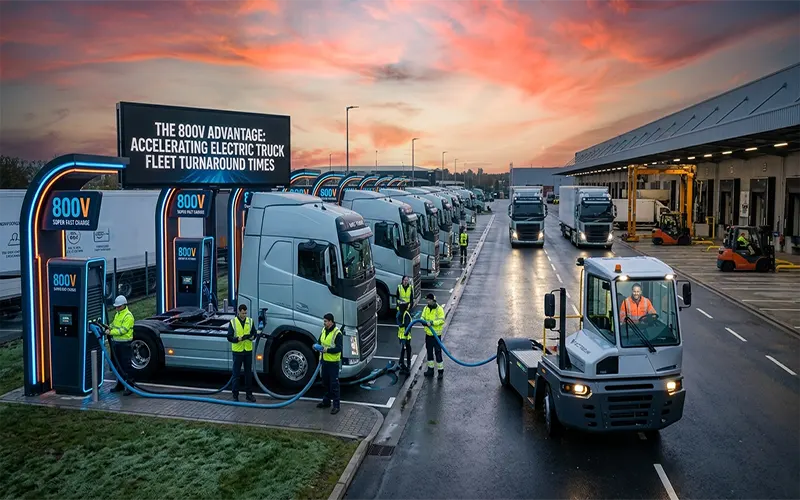
For heavy-duty electric vehicle (HDV) fleet operators, the primary metric of success is not just energy efficiency—it is uptime. In the world of logistics, a vehicle that is not moving is not earning. As electrification scales, the limitations of traditional 400V architectures are becoming a significant operational bottleneck, particularly when it comes to the time required to charge the massive battery packs needed for long-haul transport.
In 2026, the transition to 800V high-voltage architecture has moved from a luxury passenger-car trend to a fundamental requirement for the logistics industry. This shift is the primary enabler for the next generation of fleet productivity.
1. The Operational Bottleneck: Why 400V is Reaching Its Limit
Traditional 400V charging systems were designed for passenger vehicles with battery capacities typically ranging from 50–100 kWh. Scaling this architecture for an electric semi-truck with a 500+ kWh battery pack creates a massive throughput problem.
To achieve meaningful charge speeds with 400V, the current ($I$) must be pushed to extreme levels, often exceeding 800 amperes. This generates immense heat at the connector and inside the vehicle’s internal wiring, necessitating massive, liquid-cooled cables that are heavy, cumbersome for drivers to handle, and prone to rapid thermal degradation. For fleet operators, this leads to long, forced “soak” times at chargers and increased maintenance costs, effectively preventing the “in-and-out” turnaround required for competitive logistics.
2. The Physics of Power: $P = V \times I$
The advantage of 800V is rooted in the fundamental power equation: Power ($P$) equals Voltage ($V$) multiplied by Current ($I$). By doubling the voltage, we can deliver the same (or significantly higher) power while simultaneously halving the current.
Because resistive energy losses are proportional to the square of the current ($P_{loss} = I^2R$), halving the current reduces these internal heat losses by up to 75%. This efficiency gain is transformative for heavy-duty trucks:
- Reduced Thermal Stress: Components run cooler, extending the lifespan of onboard power electronics.
- Lighter Harnesses: Thinner, lighter-weight wiring can handle the same power loads, increasing the vehicle’s total payload capacity.
- Faster Throughput: Lower current allows for more stable, sustained high-power charging without hitting the thermal “derating” limits that plague 400V systems during the final stages of a charge session.
3. The SiC Synergy: Silicon Carbide Inverters
The 800V architecture works in tandem with Silicon Carbide (SiC) power electronics. SiC MOSFETs operate efficiently at higher switching frequencies than traditional silicon-based IGBTs. In an 800V truck, these SiC inverters allow for more compact power modules and smaller passive components. By reducing the size and mass of the powertrain, SiC technology further optimizes the vehicle’s efficiency, ensuring that more of the energy from the grid actually reaches the wheels, while simultaneously keeping the charging system within a manageable thermal envelope.
4. Infrastructure Integration: Future-Proofing with MCS
The move to 800V is the mandatory precursor to the adoption of the Megawatt Charging System (MCS). As of mid-2026, MCS is the gold standard for long-haul logistics, designed to provide charging speeds upwards of 1 megawatt.
While CCS2 charging (typically 350–400 kW) served the early transition, MCS—enabled by 800V-plus architectures—allows a truck to recoup 80% of its battery capacity in roughly 40–45 minutes. This aligns perfectly with mandatory driver rest periods, meaning that charging can occur during a driver’s legal break rather than as a separate, time-consuming task. Furthermore, 800V systems are inherently better at managing grid fluctuations, as the lower current draw improves the power factor and reduces stress on the depot’s local grid transformers.
5. The Economic Case: Total Cost of Operation (TCO)
For fleet managers, the 800V transition is a calculation of utilization. An electric truck that can charge during a 45-minute break is a vehicle that can compete directly with a diesel asset on long-haul routes.
- Increased Utilization: Shorter charge windows mean more time on the road.
- Payload Efficiency: Lighter wiring and smaller cooling systems mean more weight capacity for cargo.
- Backward Compatibility: Through technologies like Battery Selection Circuits (BSC), 800V-native trucks can reconfigure their packs to charge on legacy 400V infrastructure when necessary, ensuring the fleet remains flexible during the multi-year transition period.
The 800V architecture is no longer just a technical specification for performance enthusiasts; it is the backbone of efficient, high-throughput logistics. By minimizing resistive losses, enabling the megawatt-scale charging required for heavy-duty duty cycles, and integrating seamlessly with next-generation SiC components, 800V platforms provide the speed and reliability necessary for electric trucking to become the standard. For fleets looking to optimize TCO in 2026 and beyond, the move to high-voltage is the most significant strategic investment in operational uptime.