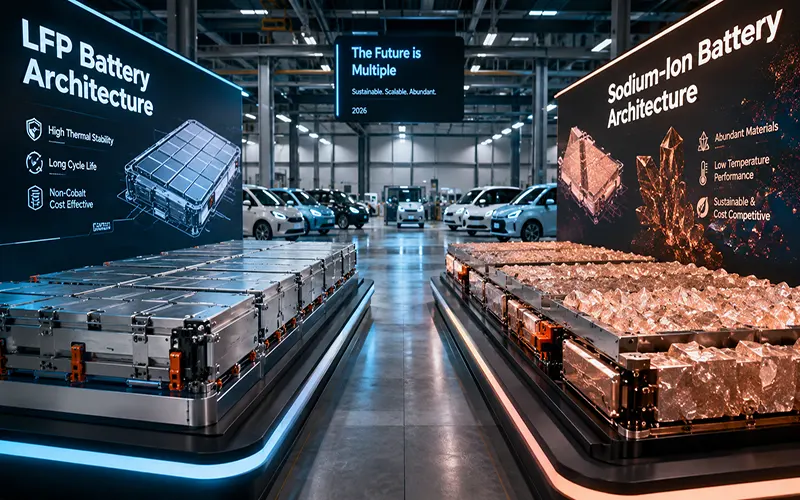
The electric vehicle (EV) battery landscape in 2026 is no longer a singular race toward higher energy density. As the industry matures, the focus has shifted toward cost-optimization, supply chain security, and use-case specialization. At the center of this debate are two chemistries: Lithium Iron Phosphate (LFP), the proven incumbent of the mass market, and Sodium-Ion (SIB), the rapidly rising challenger.
For urban electric vehicles—where range requirements are often secondary to cost and charging frequency—this comparison has become the most critical strategic decision for manufacturers and fleet operators alike.
1. Executive Summary: A Market in Transition
In 2026, LFP remains the “bankable” choice for mainstream passenger EVs. With over half of global EV batteries now utilizing LFP, the chemistry benefits from massive economies of scale, a mature manufacturing infrastructure, and established safety records.
However, Sodium-Ion has moved from the laboratory to mass production. While it is not yet displacing LFP across all vehicle segments, it is carving out a specific niche: cost-sensitive, short-range urban mobility. As of mid-2026, SIB cell costs are converging with LFP, with industry analysts projecting that the structural advantages of sodium will lead to a definitive cost-per-kWh advantage by 2027–2028.
2. Structural Cost Drivers: Why Sodium is “Cheaper by Design”
The fundamental cost gap between SIB and LFP is rooted in mineralogy and engineering.
- Raw Material Abundance: Lithium carbonate prices remain subject to market volatility. In contrast, sodium carbonate (soda ash) is roughly 500 to 800 times cheaper than lithium and is geographically abundant. This creates a supply chain that is inherently resistant to the price spikes that have historically plagued lithium-based chemistries.
- The Aluminum Advantage: Unlike LFP, which requires copper foil for its anode current collector, sodium-ion batteries can utilize aluminum foil for both the anode and the cathode. Copper is significantly more expensive and susceptible to price volatility; replacing it with aluminum provides a structural cost saving of approximately $6/kWh.
- Hard Carbon Constraints: The primary current cost bottleneck for SIB is the hard carbon anode, which accounts for 35–45% of total cell material costs. However, as production scales to meet 2026 manufacturing targets, these costs are falling rapidly along the experience curve.
3. Performance Trade-offs in Urban Mobility
For urban commuters, the “lower” energy density of sodium-ion is often an overstated disadvantage.
- Energy Density: While high-end LFP/LMFP batteries still offer superior energy density for long-range highway vehicles, city-centric EVs do not require 600+ km of range. Sodium-ion’s density (currently hitting ~175 Wh/kg) is more than sufficient for daily urban errands.
- Thermal and Cold-Weather Performance: This is where SIB shines. Sodium-ion retains over 90% capacity at -20°C, compared to ~70% for typical LFP. For urban drivers in colder climates, this eliminates the need for complex, energy-draining battery heating systems, effectively lowering the “total cost of operation” by improving real-world winter range and charging efficiency.
4. The 2026 Economic Reality: Converging Costs
Techno-economic models in 2026 place sodium-ion cell costs at $46–$62/kWh, compared to $52–$55/kWh for LFP.
| Battery Chemistry | 2026 Cost Status | Primary Cost Driver |
| LFP (Prismatic) | $52–$55/kWh | Scaled maturity; Copper current collectors |
| Sodium-Ion | $46–$62/kWh | Material abundance; Aluminum current collectors |
While SIB has achieved parity with LFP in lower-cost cylindrical formats, LFP continues to hold a lead in larger-scale, highly optimized prismatic packs. The consensus among market analysts (including Bernstein and IEA) is that by 2027, SIB will consistently undercut LFP by $15–$20/kWh, marking the moment it becomes the “default” for budget-friendly urban segments.
5. Strategic Outlook: Coexistence Over Replacement
The 2026 automotive market is not witnessing a total takeover of LFP by sodium; rather, it is witnessing a market segmentation.
- When to choose LFP: For vehicles that require a proven track record, high-volume production, or a balance of range and safety for mid-to-long-distance driving, LFP remains the superior choice. Its dominance in the mass market is backed by years of data and infrastructure.
- When to choose Sodium-Ion: OEMs and fleet operators should prioritize SIB for “micro-mobility” and city-car platforms. If your target demographic resides in climates with harsh winters or requires a vehicle with a low sticker price—and range is not the primary selling point—sodium-ion is the pragmatic, future-proofed solution.
The sodium-ion vs. LFP debate is shifting from a technical argument to an economic one. While LFP is the foundation of today’s electric mobility, sodium-ion is the catalyst for the next tier of cost-reduction in the urban EV market. For 2026 and beyond, the most successful manufacturers will not choose one chemistry to the exclusion of the other, but will instead leverage the strengths of both to optimize their portfolios for different consumer needs.