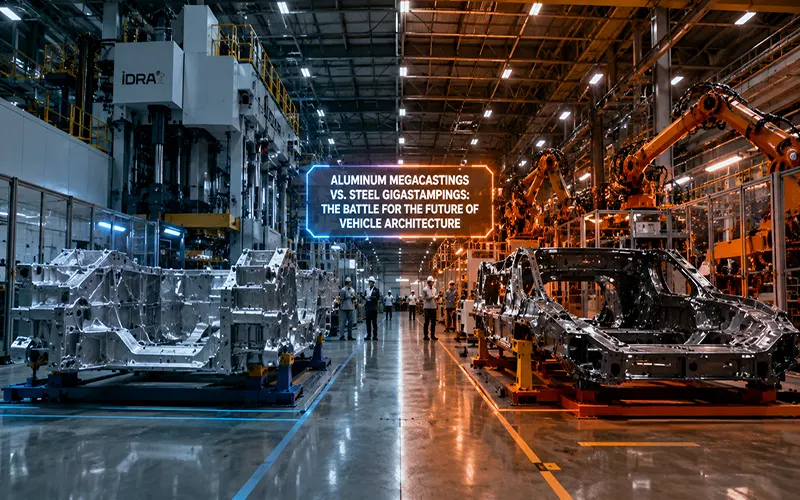
In the high-stakes world of automotive manufacturing, 2026 marks a decisive turning point. As electrification forces a radical rethinking of vehicle platforms, two competing ideologies are vying for dominance in the body-in-white (BIW) structure: the radical parts-consolidation of aluminum megacasting and the high-strength, precision-engineered optimization of advanced steel gigastamping.
1. The Architecture Pivot
For years, the industry was defined by incremental assembly. Today, we have reached an inflection point. Aluminum megacasting—the process of using massive 8,000+ ton “Giga Presses” to create large structural chassis components—promises to eliminate hundreds of individual parts and thousands of fasteners. Conversely, the steel industry is fighting back with a “Future Steel” resurgence, leveraging Advanced High-Strength Steel (AHSS) and tailored blanking techniques to match aluminum’s weight targets while preserving the manufacturing flexibility that traditional automakers have perfected over a century.
2. The Case for Aluminum Megacasting: Radical Consolidation
The allure of megacasting is simple: simplicity. By replacing 70 to 100 stamped parts with a single casting, manufacturers can eliminate the entire “joining” phase of the production line. No robots are required to weld these parts; no fasteners are needed to align them.
- Operational Efficiency: Tesla proved that megacasting slashes the “time-in-factory” for a vehicle frame by nearly 30–40%.
- Weight Parity: While aluminum is less dense than steel, its real efficiency gain comes from the elimination of overlapping material, welds, and secondary reinforcements.
- Supply Chain Resilience: By producing massive chassis sections in-house near the final assembly line, OEMs can reduce reliance on a sprawling web of Tier 1 suppliers for small metal stampings.
3. The Steel Resurgence: AHSS and “Future Steel”
Critics often argue that steel is “legacy,” but the material science behind 2026-era AHSS suggests otherwise. New martensitic and dual-phase steel grades now boast tensile strengths exceeding 1,500 MPa, allowing for thinner, lighter gauge material that can handle extreme crash loads.
- Manufacturing Flexibility: Unlike a Giga press, which requires a multi-million dollar CAPEX investment and a specialized foundry, steel stamping lines remain the ultimate “Swiss Army Knife” of manufacturing. They can be re-tooled for different models in a matter of days.
- The “Future Steel” Advantage: Through techniques like tailored blanks—where different thicknesses and grades of steel are laser-welded before stamping—manufacturers can put high strength only where it is needed, keeping the rest of the structure light.
4. The Repairability Crisis: The “Total Loss” Trap
The most significant headwind for megacasting in 2026 is the repairability dilemma. When a structural component is one single, massive casting, you cannot simply “replace the damaged piece.”
For insurance companies and second-hand owners, this is a financial nightmare. A minor collision that damages a frame-integrated megacast can often render the entire vehicle a “total loss,” as there is no standardized, safe way to weld or straighten an aluminum cast structure. While some OEMs are now designing “sacrificial” crumple zones that can be bolted to these casts, the perception remains: megacastings are “disposable” chassis architecture, whereas stamped steel frames remain fundamentally repairable.
5. Economics and Supply Chain CAPEX
The CAPEX barrier is the final frontier. A Giga press setup is a massive, permanent commitment to a specific vehicle platform. If the market demand for a specific model shifts, that multi-ton machine cannot be easily repurposed.
Steel stamping, by contrast, thrives on modularity. As global trade dynamics and tariff volatility shape the 2026 landscape, the ability of traditional steel stamping lines to adapt to different vehicle models, sizes, and regional requirements offers a strategic “operational buffer” that megacasting lacks.
The Hybrid Future
The battle between megacasting and gigastamping is not a winner-take-all scenario. By 2030, the most sophisticated vehicle platforms will likely adopt a hybrid architecture.
Expect to see aluminum megacasts used in the high-stress structural nodes (like the rear underbody or front shock towers) where consolidation provides the most weight benefit. Simultaneously, AHSS will continue to underpin the safety cage, battery protection structures, and modular chassis segments where versatility and repairability are paramount. The future of the vehicle is not made of just one material—it is a carefully optimized mosaic of both.