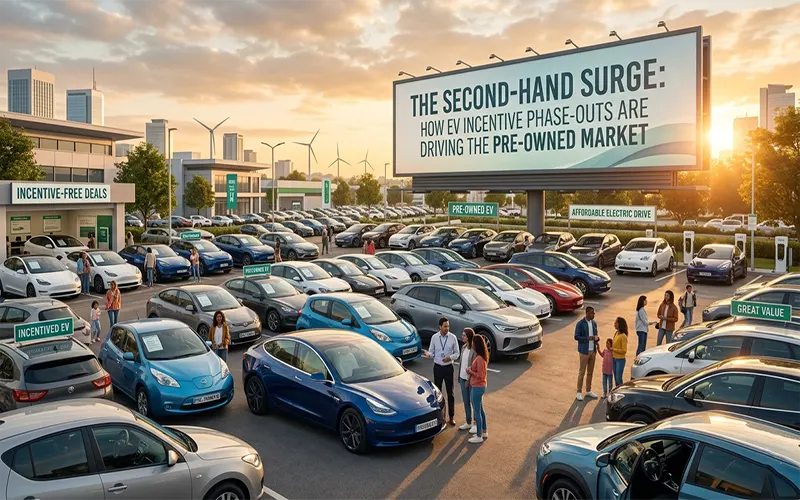
For several years, the narrative surrounding electric vehicle (EV) adoption was dictated by government largesse. Tax credits, purchase rebates, and infrastructure grants formed the scaffolding upon which the transition to electric mobility was built. But as we move through 2026, the industry is witnessing a profound shift: the era of “subsidy-driven” growth is giving way to a more mature, value-driven market.
While the sunsetting of federal and regional tax credits has caused a temporary softening in new EV sales—a drop of nearly 28% in the U.S. in Q1 2026—this policy transition has paradoxically triggered a golden age for the pre-owned EV market.
1. The Post-Subsidy Paradox
The divergence between new and used EV performance in 2026 is one of the most significant trends in automotive history. As federal tax credits for new EVs have become more restrictive or expired entirely, the “new car” barrier for middle-class consumers has risen. Financing costs remain elevated, and without the price-offset of a hefty government rebate, many prospective buyers are steering clear of the new-car showroom.
However, this cooling of new EV demand has cleared the path for the pre-owned sector. Consumers who were priced out of the new market have turned to used inventory, where the “subsidy” is effectively already baked into the price—not by the government, but by the rapid depreciation that early adopters absorbed.
2. The “Lease-Return” Flood
The current boom in used EV availability is largely the result of a “lease-return” cycle initiated three years ago. The 2023–2025 window saw record-high leasing penetration, fueled by creative manufacturer incentives. As these three-year leases conclude in 2026, high-quality, tech-forward EVs are flooding dealer lots.
This inventory is reaching the secondary market at a time when consumer trust in battery longevity has reached an all-time high. Improved transparency, such as third-party battery health certification, has removed the “fear of the unknown” that once plagued used EV sales, turning these lease returns into highly coveted assets.
3. The Affordability Cross-Over
The most telling data point of 2026 is the rapid narrowing of the price gap between electric and internal combustion engine (ICE) vehicles. In some regions, the premium for a used EV over a comparable ICE vehicle has collapsed to as little as $1,300—a statistical rounding error in the world of auto finance.
This price parity is a watershed moment. It signifies that the secondary market has fully internalized the lower total cost of ownership (TCO) of an EV. Buyers are now prioritizing the long-term savings on electricity and maintenance over the lower upfront cost of a traditional gasoline-powered used car, effectively normalizing EV ownership for the average commuter.
4. Shifting Depreciation Curves
For years, the “high-risk” label of early-generation EVs suppressed residual values. That era is effectively over. With 2026-era battery health metrics showing consistent 95%+ capacity retention even after five years, the “tech-risk” associated with EVs is evaporating.
Used EVs are now viewed by finance professionals as stable assets. This stability is attracting sophisticated fleet operators who are pivoting their portfolios away from expensive-to-maintain diesel vans toward reliable, low-maintenance pre-owned electric models. The “depreciation trap” has been replaced by a “stability premium,” as the predictability of electric maintenance outweighs the variable costs of a aging internal combustion engine.
5. Global Regional Divergence
The market’s reaction to incentive phase-outs varies by region, creating a “two-speed” world:
- The U.S. “Holding Pattern”: The American market is currently defined by a wait-and-see approach, with high new-car inventory levels forcing a pivot toward used-market dominance.
- European and Asian Acceleration: In markets like the UK, Germany, and parts of Southeast Asia, high fuel prices are acting as a “shadow subsidy.” Here, the phase-out of purchase incentives hasn’t dampened the appetite for used EVs; instead, it has intensified demand, as consumers treat electric vehicles as a hedge against volatile fossil fuel costs.
Normalizing the Electric Shift
The end of the “subsidy era” has not signaled the end of EV adoption; rather, it has signaled the end of its infancy. By forcing prices to reflect actual market value rather than government policy, the phase-out of incentives has forced the industry to deliver what consumers have always wanted: an affordable, practical, and reliable vehicle.
As we look toward the remainder of 2026, the pre-owned EV is no longer a niche choice for early adopters or environmentalists. It has become a commodity—a smart, economical, and inevitable choice for the mainstream driver. The subsidy might be gone, but the momentum for electrification is now stronger than ever, driven by the most powerful incentive of all: market-driven affordability.