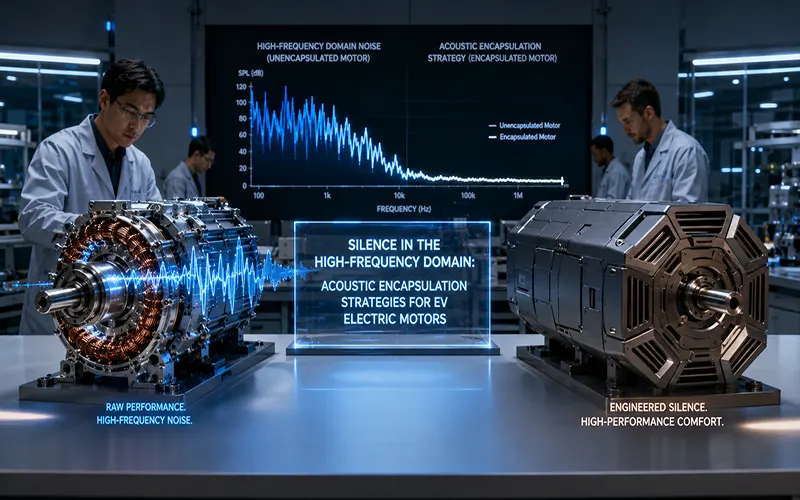
The transition to electric mobility has fundamentally altered the automotive acoustic landscape. While the removal of the internal combustion engine (ICE) has eliminated the low-frequency “rumble” of pistons and explosions, it has unveiled a new, more piercing set of acoustic challenges. In the 2026 automotive market, where cabin silence is a primary metric of luxury, the high-frequency “whine” emanating from electric drive units has become the preeminent NVH (Noise, Vibration, and Harshness) hurdle.
1. The NVH Paradigm Shift
In legacy ICE vehicles, the engine functioned as an acoustic “mask.” Its broadband noise profile naturally obscured the lower-level mechanical and electrical sounds of the powertrain. In an electric vehicle (EV), that mask is gone. Occupants are now sensitive to the high-frequency tonal noise generated by the drive unit, particularly the inverter switching frequencies and electromagnetic forces within the motor. Because this noise is tonal—often occurring in the 5 kHz to 20 kHz range—it is perceptually “sharp,” making it far more fatiguing to the human ear than the broad-spectrum sound of an combustion engine.
2. Sources of High-Frequency Noise
Understanding the physics of this noise is the first step toward mitigation. Two primary phenomena dominate:
- Electromagnetic Excitation: The interaction between the stator’s magnetic field and the rotor creates Maxwell forces that cause the stator teeth to deform and vibrate. These vibrations occur at multiples of the switching frequency of the power electronics, resulting in the characteristic high-pitched whine.
- Magnetostriction: The physical deformation of the stator core material as it is magnetized and demagnetized leads to additional high-frequency vibrations.
- Mechanical Sources: Rotor eccentricity and bearing dynamics also contribute to tonal noise, though these typically manifest as lower-frequency harmonics compared to the inverter-driven electromagnetic noise.
3. Encapsulation Materials Science
Effective mitigation requires a multi-material approach, as no single substance can address the full spectrum of EV powertrain noise.
- Polyurethane (PU) Foams: These remain the industry standard for high-frequency absorption. Their open-cell structure effectively traps high-frequency waves (above 5000 Hz), converting acoustic energy into heat. Their lightweight profile makes them ideal for mass-conscious EV designs.
- Viscoelastic Rubber/Laminates: To combat structure-borne noise, viscoelastic damping layers are applied directly to the motor housing. By acting as a “constrained layer damping” (CLD) system, they increase the energy dissipation of the housing itself, shifting resonance modes outside the sensitive frequency range.
- Sustainable Natural Fiber Composites: A significant trend in 2026 is the use of natural fibers (such as betel nut or sugarcane) integrated into polyurethane matrices. These composites offer sound absorption coefficients (SAC) that rival synthetic materials while significantly improving the sustainability profile of the vehicle’s “cradle-to-gate” carbon footprint.
4. The Encapsulation Design Challenge: Thermal vs. Acoustic
The “Holy Grail” of motor encapsulation is a housing that is acoustically opaque but thermally transparent. Inverters and motors generate massive heat loads; completely sealing a unit in acoustic foam can lead to thermal derating, where the motor must throttle its power to prevent damage.
Engineers are solving this through intelligent multi-layering. By using thermally conductive acoustic foams—which integrate ceramic fillers into the foam structure—manufacturers can create shields that manage heat rejection while simultaneously attenuating high-frequency airborne noise. Furthermore, the design of “acoustic labyrinths”—ventilation paths that allow airflow but force sound waves to bounce against absorbing surfaces—is becoming standard practice.
5. System-Level Integration
Encapsulation is only half the battle. If the motor is rigidly mounted to the chassis, the high-frequency vibrations will bypass the acoustic shield through the mounting points (structure-borne transmission). Modern E-Drive units now utilize:
- Decoupled Powertrain Mounts: Hydraulic or advanced elastomer mounts that act as a low-pass filter, blocking high-frequency vibrations from entering the subframe.
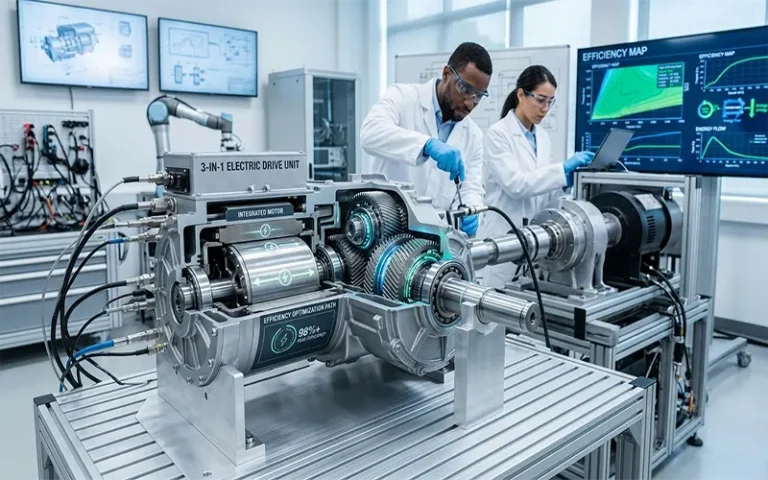
- Integrated Drive Units (IDUs): By housing the motor, gearbox, and inverter in a single, structurally optimized casing, engineers can use CAE (Computer-Aided Engineering) to “tune” the housing to have higher natural frequencies, thereby reducing the likelihood of resonant amplification of the motor’s operating frequencies.
6. Future Outlook: The Rise of Metamaterials
The next frontier in EV NVH is the use of acoustic metamaterials. Unlike traditional foams that rely on mass and absorption, metamaterials use periodic geometric structures to manipulate sound waves at the sub-wavelength scale. These engineered surfaces can be “tuned” to provide near-perfect reflection or absorption at specific, highly annoying tonal frequencies, effectively canceling the “whine” of the motor without adding significant weight or thickness to the drive unit.
As we move toward 2030, the goal is clear: the EV powertrain should not be heard at all. Through the sophisticated combination of material science, predictive CAE modeling, and metamaterial geometry, the “electric whine” is being engineered out of existence, ensuring the cabin remains a sanctuary of silence.